

The Detroit Pistons are entering spring with real playoff aspirations for the first time in two decades. Having won more games than any season since 2008, the Pistons are on the verge of clinching the No. 1 seed in the East and hope to make a deep postseason run. Regardless of how far they go this season, however, the Pistons are still in the early stages of title contention. The most important members of this core are still ahead of their prime. With the right moves, the Pistons can contend for years to come.
That is why it's important to keep one eye on the future. The Pistons have to make savvy front office decisions to keep their roster championship-caliber going forward. That requires knowing who to retain and when to move on from players. Barring unexpected developments between now and when the Pistons' season ends, the organization should have little interest in keeping the following veterans.
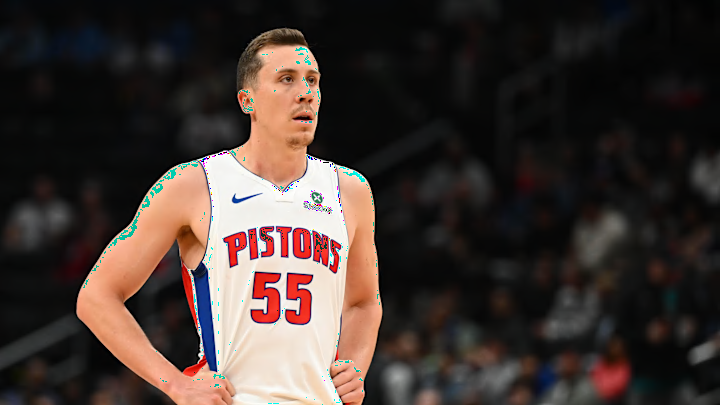
Duncan Robinson
Robinson plays a key role for this team. He is the only elite shooter, making him an indispensable member for this year's playoff run. At the same time, the Pistons shouldn't be this dependent on a player with such significant weaknesses as Robinson.
Detroit has to play Robinson extended minutes because they need him to space the floor. As a 40% shooter from downtown, he does an excellent job at that.
On the other end of the floor, however, he has a target on his back. He gives opposing offenses an obvious place to attack, as he is not strong enough to guard forwards and not quick enough to defend smaller players.
If the Pistons are going to be a championship contender, they need to upgrade Robinson's spot in the starting lineup. He would be a worthy rotation player coming off the bench and boosting the team's offense. The problem is, he doesn't get paid like a bench player.
Robinson is due almost $16 million next season. The good news is that only $2 million of that salary is guaranteed. The Pistons can either guarantee that salary and trade him, or let him go to give themselves financial flexibility. They should be able to get a two-way player for that salary.
Caris LeVert
If Robinson is too big a defensive liability for the Pistons, LeVert poses the same challenge on the other end of the floor. The 31-year-old shooting guard has taken a significant step back offensively this season, which makes him a tough fit. Due $14.8 million next season, LeVert is a prime trade candidate. The Pistons could add draft compensation to his expiring salary and get an upgrade on the trade market.
LeVert is a useful player, especially defensively. JB Bickerstaff clearly trusts him to take on tough defensive matchups. The problem is on the other side of the ball. LeVert can handle the ball and run a pick-and-roll, but his shot has abandoned him. He makes 32.5% of his threes and 48.9% of his twos, giving him a miserable 51.1% True Shooting for the season. Add in the fact that he is averaging a career-high in turnover rate, and LeVert becomes a weak link in the rotation.
With the emergence of Daniss Jenkins, the Pistons don't desperately need LeVert. Jenkins can become the full-time backup point guard. Detroit could use LeVert's salary slot to add another elite shooter on the perimeter.
Marcus Sasser
Sasser has one more season left on his contract, but it's hard to see him in Detroit this time next year. The third-year player had his chances to establish himself as a surefire rotation player for the Pistons, but wasn't able to do so.
First, it was a hip injury early in the season that kept him out for a month when the team could have used him. By the time he returned, Jenkins had already taken over as the backup point guard. He was quickly marginalized in the depth chart and was in and out of the rotation for much of the year. In Cunningham's absence over the last two weeks, Sasser has gotten more of a chance, but he has been inconsistent in his production.
Sasser can shoot the ball and run the pick-and-roll. He is a solid offensive player who can stretch the floor with his off-the-dribble shooting. Everything else in his game, however, needs improvement. His defensive shortcomings make it hard for Bickerstaff to trust him, especially given Jenkins' high-level performance.
The 25-year-old should still have some trade value around the league. Before having to give him a contract extension or lowering his trade value further by waiting too long to move him, the Pistons should and likely will consider trading him over the summer.
More Detroit Pistons news and rumors:
 Add us as a preferred source on Google