

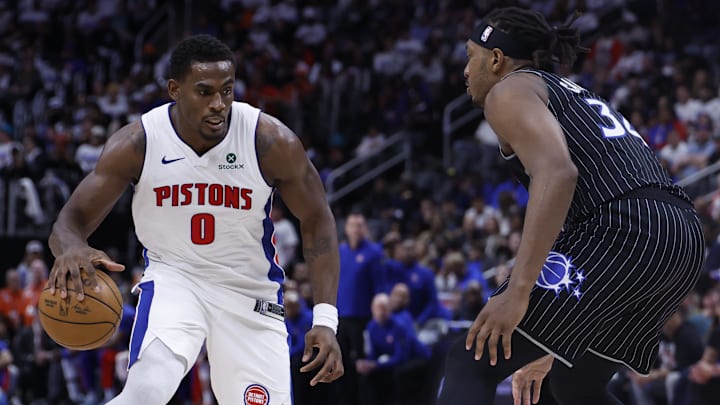
Sunday's 112-101 loss was certainly not the playoff home opener the Detroit Pistons had in mind. Taking on the Orlando Magic with a significant rest advantage, the Pistons were outplayed all game and never led in Game 1, as they were outscored in all but one quarter.
Now, the Pistons have a ton of reflection to do to turn things around before Game 2 on Wednesday. To do that, however, head coach J.B. Bickerstaff & Co. need to understand what went wrong in the series opener and how to prevent those mistakes from popping up again.
3 Game 1 Mistakes the Pistons Can't Repeat
1. Pistons Couldn't Get Jalen Duren Going
This was arguably the worst game Jalen Duren played this season.
In 33 minutes of action, the first-time All-Star had eight points, seven rebounds, one assist, and three turnovers. More concerning was his taking only four shots from the field and four free throws. As a result, Duren was a team-worst minus-21 in his minutes.
Duren certainly needs to be aggressive. He has to be more active on the offensive board and fighting for position to get seals under the basket like he has done all season.
At the same time, it's as much on the rest of the team as it is on Duren. The Pistons missed him on a couple of possessions. As good an offensive player as Duren is, he is still a center who largely depends on others to create for him. Detroit needs to be more intentional about getting the ball to him.
2. Defensive Plan, Execution Left Plenty to Be Desired

More disappointing than Detroit's inability to get going on offense, however, was their defense. The second-best defense in the league in the regular season gave up a 113.1 offensive rating to a mediocre Magic offense.
Duren was as big a problem defensively as he was offensively. The Pistons allowed a whopping 13-of-15 shooting at the rim in the halfcourt when Duren was on the floor. His help defense was non-existent as the Pistons allowed a parade of Magic drivers to get to the basket and finish.
Paolo Banchero was unperturbed by Tobias Harris' defense all game, and the Pistons didn't try to change up the matchups. Ausar Thompson chasing Desmond Bane on the perimeter all game prevented him from being active as a help defender. Duncan Robinson was taken advantage of defensively throughout the game as he got in trouble and struggled to guard Jalen Suggs.
In the end, the Pistons couldn't put enough pressure on the ball and force turnovers like they did all season.
3. J.B. Bickerstaff's Questionable Rotation Decisions

The Pistons continued to run a deep rotation, playing 11 players. However, it seemed like Bickerstaff was pushing all the buttons in his PS5 controller rather than trusting his team.
Javonte Green played fewer than minutes despite the Pistons winning his minutes by four and him looking solid defensively. Instead, he relied on Daniss Jenkins for long stretches despite the backup point guard not getting going all game. Jenkins ended up playing 22 minutes but was 1-of-7 from the field for six points and two assists. The Pistons lost these minutes by 11 points.
Bickerstaff understandably wants more shot creation and playmaking on the court, but the Pistons were struggling to get stops and needed more bodies. When Cade Cunningham is on the floor, Jenkins doesn't make as much sense, especially if his three-ball isn't falling. After trusting Caris LeVert all season, not playing him at all in the second half of the game when the Pistons could have used his defensive intensity and playmaking was also a head-scratcher.
Pistons fans know that Bickerstaff can coach much better than he did on Sunday, leaving it up to the Pistons' bench boss to quickly erase any doubts early in Game 2.
More Detroit Pistons News & Rumors:
 Add us as a preferred source on Google