

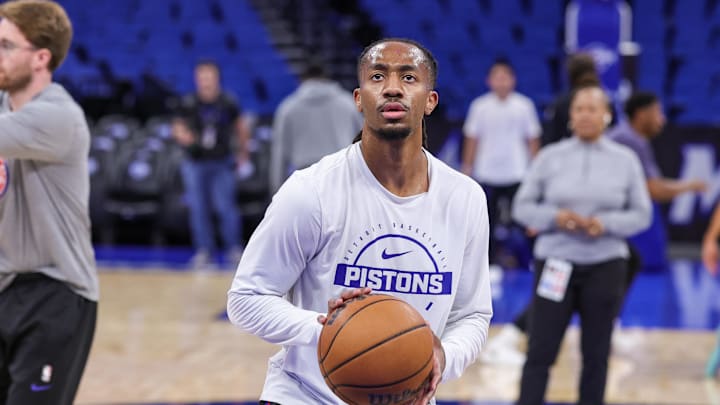
The Detroit Pistons will embark on their playoff run with Game 1 of their opening round series in the Eastern Conference playoffs on Sunday. While they await an opponent to emerge from the Play-In Tournament, the Pistons have a chance to rest and finalize their game plan.
One of Detroit's biggest advantages throughout the 2025-26 campaign was its depth. JB Bickerstaff used a ten-man rotation for much of the season and got key contributions up and down the roster. The playoffs, however, are a different beast. Certain players will struggle and fall behind in the rotation, while others have to step up and seize the opportunity.
Outside of their All-Star duo of Cade Cunningham and Jalen Duren, the Pistons have a long list of role players who can make an impact on any given day. Let's take a look at their X-factors heading into the postseason, who can swing a playoff game or series and will therefore decide how far the Pistons can go.
1. Kevin Huerter
The Pistons have shot the ball much better in recent weeks, but perimeter shooting remains a weakness for the team. There are no elite shooters outside of Duncan Robinson, which can cramp spacing and make things difficult on Cunningham.
That is, unless Kevin Huerter makes some shots.
On paper, Huerter is one of the best shooters on the team. But this season, his 3-point prowess has abandoned him. He has made 29.4 percent of his 3s since arriving in Detroit. In his last nine games, however, he has converted at a 40 percent clip from downtown.
If this trend continues, the Pistons will have another perimeter weapon that defenses have to scheme against. If Huerter is shooting like he was earlier in the season, however, it won't take long for him to be out of the rotation, which will, in turn, hurt the Pistons offensively. This will be a big swing factor for a team that is already low on offensive juice.
2. Ron Holland
It has been a frustrating season for Holland. The second-year player wasn't able to take the big step forward that many fans were hoping for. If anything, his numbers on the offensive end were worse than his rookie campaign.
On the other hand, Holland is a chaos agent who can swing games with his defensive intensity and all-out effort. He forces a ton of turnovers, gets offensive rebounds, and is a wrecking ball in transition. He helps the Pistons control the possession game by always finding small ways to impact winning with his hustle.
There will be games in which Holland misses shots, allowing opposing defenses to fall off of him in favor of packing the paint. This could make him unplayable in certain matches. If he can find a way to survive in half-court offense, Holland can make a big impact in the floor game, swinging a game or two to the Pistons.
3. Daniss Jenkins
Jenkins has been a revelation for the Pistons for most of the season. He emerged out of nowhere to earn the backup point guard role and held that job down the stretch. The guard helped Detroit weather Cade Cunningham's absence, with his play being one of the main reasons why the Pistons were 13-5 without Cunningham in the lineup.
The issue with Jenkins is, perhaps unsurprisingly, consistency. When he starts and has the ball in his hands, he thrives in that big offensive role. As a starter, he has a 54.9 percent True Shooting on a 23.1 percent usage rate, averaging 17.2 points and 7.4 assists in 33.8 minutes per game.
As a reserve, he has a 50.5 percent True Shooting on a 20.5 percent usage rate, averaging 6.5 points and 2.6 assists in 15.3 minutes per game. There is a clear difference between the two, and Bickerstaff will have to be cognizant of that fact once the stakes are raised this weekend.
In the playoffs, Jenkins will have a small role behind Cunningham, likely playing around 15 minutes per game. He has to be able to drive semi-efficient offense against second units. Otherwise, the Pistons may struggle to score enough without Cunningham. Detroit will then have to find another solution for those non-Cunningham minutes, which would be a less-than-ideal spot at this stage of the season.
More Detroit Pistons news and rumors:
 Add us as a preferred source on Google