

The Detroit Pistons are no strangers to a trade deadline deal.
Over the years, the team has netted several key contributors to championship runs at the deadline. But which transaction has the most credible claim of being the best in franchise history?
Before the 2025 NBA trade deadline — which could pack its own surprise — we rank the Pistons’ top five trade deadline acquisitions.
5. Reggie Jackson (Feb. 19, 2015)
Detroit was far from its 2000s peak by the 2015 NBA trade deadline. Instead, the Pistons were finding themselves in the midst of a seventh consecutive losing season. They hadn't made the playoffs since 2009, with the six-year drought tied for the team's longest since the 1976 NBA/ABA merger.
Detroit received a minor jolt in trading for Jackson, who primarily came off the bench in his first 3.5 NBA seasons with the Thunder. But with the Pistons, Jackson started 285 of his 287 games, including all 82 during the 2018-19 season. Before being traded 14 games into the 2019-20 campaign, Jackson, a 2023 NBA champion with the Denver Nuggets, averaged 16.2 points and 5.6 assists per game across six seasons with the organization.
In his first full season (2015-16), the Pistons returned to the playoffs after finishing the regular season with a 44-38 record. It was a brief return to form, though, with Detroit being swept in the first round of the playoffs and posting back-to-back losing records in 2016-17 and 2017-18.
Compared to other Pistons trade deadline deals, the Jackson acquisition wasn't nearly as impactful. But Detroit was the clear winner of the three-team deal. None of the other players involved besides Freedom (née Kanter) moved the needle on their next teams, while the draft picks the Pistons dealt turned into journeyman center Thomas Bryant (2017 first) and former NBA guard Isaiah Roby (2019 second), who most recently played professional basketball overseas.
4. Corliss Williamson (Feb. 22, 2001)
Of the two trade deadline deals that played a role in the Pistons' third NBA championship, Williamson's addition is much less heralded.
A 1995 first-round pick by the Sacramento Kings, Williamson was on his third team in less than a year when moving to Detroit, first being traded to the Toronto Raptors ahead of the 2000-01 season. But after just 42 games north of the border, he was dealt to the Pistons, who were floundering at 21-33, 3.5 games out of eighth in the Eastern Conference.
The trade had all the makings of being lost to the dustbins of history — a marginal deal between teams and players going nowhere — but Williamson had other ideas.
In his first eight games with the Pistons, he averaged 16.5 points, with head coach George Irvine telling reporters, "Corliss has been a huge addition for us on both ends of the floor" after scoring 26 points in a win over the division-rival Indiana Pacers. (h/t ESPN.com)
While he proved his worth immediately, his most impactful years came later as a key bench piece.
During the 2001-02 season — first full season in Detroit — Williamson earned Sixth Man of the Year honors, and he followed that with fifth and 10th place finishes the next two seasons, the last ending in the Pistons' five-game NBA Finals triumph over the Los Angeles Lakers. Over those three years, Williamson appeared in 239 games, starting just eight times and averaging 11.7 points and 3.9 rebounds in 22.3 minutes per game.
The trade was a massive win for Detroit. Montross only played 61 games with the Raptors through the end of the 2001-02 season before retiring, while Williams spent two unexceptional full years in Toronto before being traded to the Bulls.
3. James Edwards (Feb. 24, 1988)
Before there was ever Williamson, Edwards, acquired the day before the 1988 trade deadline, provided valuable frontcourt depth off the bench for a Pistons championship team.
The 7-foot-1 center, selected No. 46 overall pick in the 1977 NBA Draft, had successfully returned from injury the previous year, starting 42 games for the Suns before the 1988 trade deadline. But after joining the Pistons, Edwards served in a backup role through Detroit’s NBA Finals sweep of the Los Angeles Lakers. He played a huge role off the bench in the title-clinching win, scoring all 13 of his points in the fourth quarter of a 105-97 victory.
When power forward Rick Mahorn left via expansion draft following the 1989 season, Edwards started 70 of 82 regular-season games en route to a 1990 repeat, averaging 14.5 points per game.
The 19-year NBA veteran played four seasons with the Pistons, but they were an undeniable success. Detroit reached the Eastern Conference Finals each year, with its only loss coming in 1991 at the onset of Michael Jordan’s dynastic decade-long run with the Chicago Bulls.
As for Moore, he appeared in five games for the Suns before calling it quits, while that second-round pick sent to Phoenix turned into Richard Dumas, who was permanently banned by the NBA in 1995 after multiple failed drug tests.
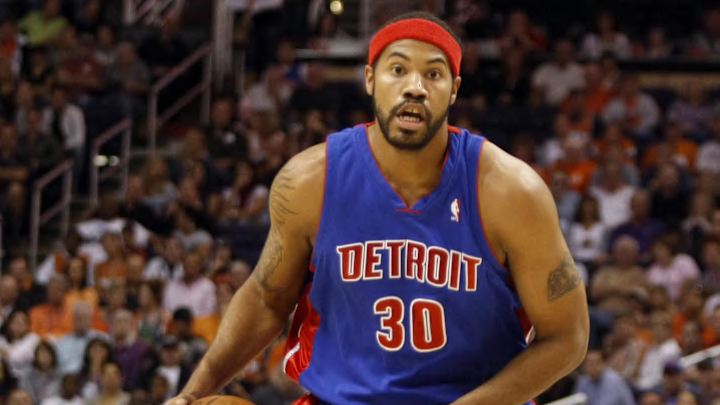
2. Rasheed Wallace (Feb. 19, 2004)
Then-Pistons general manager Joe Dumars swung big at the 2004 trade deadline, and Wallace turned out to be the missing piece for the team’s third NBA championship.
“I knew in my heart of hearts that we weren’t good enough to win it all,” Dumars told reporters months after acquiring Wallace. “I knew it would take an impact player … to put us over the top.
”There’s no question in my mind that Rasheed Wallace was that guy,” Dumars continued, per Deseret.com.
Detroit had to part with two first-rounders — which turned into longtime NBA veterans Josh Smith and Tony Allen — to land Wallace, who established himself as an aggressive, hard-nosed frontcourt presence in seven seasons with the Portland Trail Blazers.
The deal carried risk with Wallace set to become an unrestricted free agent at the end of the season, but he was the perfect fit for an already outstanding defensive team. Over the final 26 games of the regular season with their trade-deadline acquisition, the Pistons allowed 78.9 points per game and went 20-6. During the playoffs, they held their opponents under 100 points in 22 of 23 games, with the lone exception being a triple-overtime loss to the New Jersey Nets.
Wallace re-signed on a five-year deal that offseason, keeping the championship core together. And while the group never matched those heights, it fell one win shy of repeating as champions the following season as part of a span of six consecutive trips to the Eastern Conference Finals (2003-08).
1. Bill Laimbeer (Feb. 16, 1982)
Detroit's best trade deadline acquisition was a buzzer-beater.
In 1982, the Pistons landed center Bill Laimbeer, who would go on to become synonymous with the "Bad Boy Pistons" of the late 1980s and early 1990s, from the Cleveland Cavaliers in a trade finalized 15 minutes before the deadline.
After playing in a backup role before he arrived in the Motor City, Laimbeer “was considered a throw-in to the deal,” with Carr, who averaged 15.2 points per game the previous season, the crown jewel. (h/t NBA.com)
But Laimbeer was instantly inserted into the starting lineup in Detroit and averaged 12.8 points and 11.3 rebounds per game the rest of the regular season, signaling what was to come. He played in an NBA-record 685 consecutive games from 1982-89 and averaged a double-double each season.
The trade didn't pay immediate dividends on the court, with Detroit going 39-43 in 1981-82 then 37-45 in Laimbeer’s first full season (1982-83). While that might improve the case for Wallace being No. 1, Laimbeer's impact on the franchise was so massive that it’s hard to pick anyone else.
Without his attitude and toughness, Detroit may not have developed the hard-nosed, gritty reputation it turned into a championship formula.
It’s impossible to tell the history of Pistons basketball without stressing Laimbeer’s impact. And Detroit only landed him with a last-second trade-deadline heave.
More Detroit Pistons News and Rumors:
 Add us as a preferred source on Google