

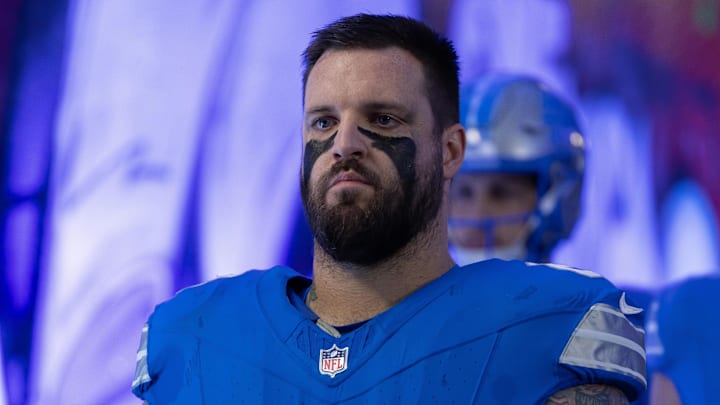
The Detroit Lions made a surprising move this offseason when they decided to release longtime offensive tackle Taylor Decker. Decker had been on the blind side for the Lions for a decade. However, when the two sides disagreed on a salary for the 2026 season, they decided that going their separate ways was the best solution.
Lions fans may disagree, considering it blasted a huge hole along an offensive line that had plenty of issues a year ago. Despite those potential concerns from fans, the team may already be in a better spot. After the first wave of free agency, the Lions made several key additions that should help them become a better team next year and potentially bridge the gap that kept them out of the postseason one year ago.
Lions Collect Multiple Benefits After Taylor Decker’s Release
The Lions' free agency hasn’t been splashy, but that doesn’t mean it can’t produce next fall. The biggest moves Detroit has made following Decker’s release have been along the offensive line, where Cade Mays and Larry Borom have come aboard. As of this writing, both players will be counted on to provide better play as projected starters next season.
The decision to release Decker also helped Detroit make another key move by adding D.J. Wonnum to the defensive side of the ball. While Wonnum isn’t a high-sack player like Al-Quadin Muhammad was for the Lions last season, he has a better all-around game that should help Detroit get more pressure on the quarterback and improve its run defense.
Those three players were added for a combined $10.73 million this offseason. With Decker scheduled for a $21 million cap hit before his release, Dan Campbell admitted when speaking to reporters at the NFL’s annual meetings this week, those signings wouldn’t have happened if the veteran tackle were still on the team.
“There was a path [for him to come back],” Campbell said, via Dave Birkett of the Detroit Free Press. “It was on a reduced price, but yeah, we were willing to. But we knew we needed help too. And that was kind of a little bit of, with Decker and David [Montgomery], we get some capital to where we now can use it on free agents.”
While the free agents provide an immediate boost with Decker’s departure, there’s also a long-term benefit. The Lions are getting ready to extend several members of their 2023 draft class, and there’s a good chance that a lot of their offseason spending will be invested into the future instead of big splashes in free agency in 2026.
Spotrac currently projects running back Jahmyr Gibbs to get an extension worth $20.2 million per season. Linebacker Jack Campbell ($21.5 million) and tight end Sam LaPorta ($17.0 million) are also expected to command big money, and Detroit could still work out a short-term extension with safety Brian Branch ($20.0 million market value) as he recovers from a torn Achilles.
The last part sounds far-fetched as Branch will likely miss a chunk of the upcoming season after getting hurt last December. But it’s something the Green Bay Packers did with Christian Watson as he recovered from a torn ACL last summer, so it isn't completely out of the realm of possibility, as this is a copycat league.
These four players emphasize the need to keep the Brinks truck full this summer and were part of general manager Brad Holmes’s explanation as to why the Lions didn’t go all-in during free agency.
“We’re trying to keep our sustainability at a good level,” Holmes said, via Pride of Detroit’s Jeremy Reisman. “We’re not trying to do this one-and-done kind of thing. You can [take] two different approaches. You can be, let’s not extend these players and then let’s get more expensive free agents. Well, are we sure that’s the right move? Is that going to give us the right amount of sustainability that we’re looking for? Those are the decisions that we’re always weighing.”
Decker was not a free agent, but his massive cap hit would have made spending on the Lions roster difficult. It was also a risk to bring him back at his current salary after he navigated a shoulder injury for most of last season and eliminate the depth that Detroit has struggled to find over the past few years.
It also would have prevented a bigger plan to move Penei Sewell to left tackle and potentially select a right tackle to either learn behind Borom or compete with him during next month’s draft.
In the end, the Lions have used Decker’s departure to their advantage, and it should continue to benefit Detroit as it approaches the 2026 campaign.
More Detroit Lions News & Rumors:
 Add us as a preferred source on Google