

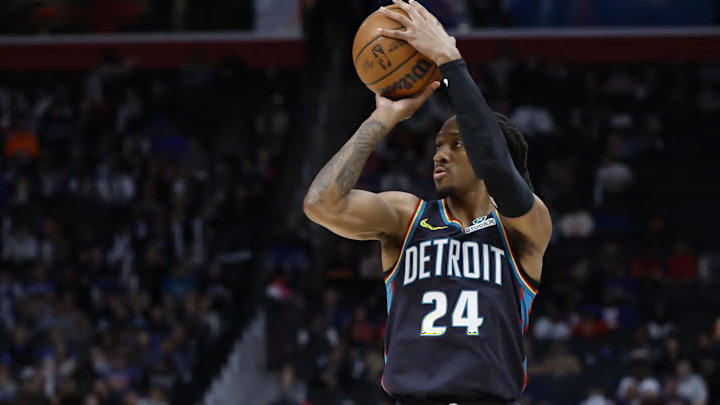
When the Detroit Pistons received the devastating news that Cade Cunningham suffered a collapsed lung three weeks ago, many expected the No. 1 seed in the Eastern Conference to struggle down the stretch. Whether the Pistons would be able to hold onto their spot was openly discussed.
Instead, they responded admirably and have gone 9-2 since Cunningham was injured. This has clinched them home-court advantage until the NBA Finals with still four games left in their regular season.
A big reason for Detroit's success has been the play of Daniss Jenkins. The backup guard moved into the starting lineup in Cunningham's absence and stepped up massively.
In this 11-game span, Jenkins has put up 18.6 points, 4.2 rebounds, and 7.6 assists per game on .447/.460/.902 shooting splits. He has averaged over 34 minutes per game, and the Pistons have won his minutes by an average of 9.8 points per game. The only losses for Detroit in this span came in overtime against the Atlanta Hawks and the Oklahoma City Thunder.
Jenkins has obviously earned himself a significant role even after Cunningham returns. He will be the primary creator when Cunningham is on the bench, but should get some minutes next to the Pistons star as well.
Pistons Should Have Signed Daniss Jenkins to a Longer Deal
The decision to sign Jenkins to a guaranteed deal during the season was clearly the correct one. The 24-year-old guard had begun the season on a two-way deal, and would have been ineligible to play more than 50 regular-season games or appear in the playoffs. While the Pistons' decision to convert him to a standard deal was a no-brainer, they almost certainly must be regretting not signing Jenkins to a longer-term deal.
The Pistons signed Jenkins to a two-year, $7.8 million deal after the trade deadline. The second year of the deal, meaning next season, is a $4 million team option. The Pistons would love to exercise that option. The other alternative would be to turn that option down to sign Jenkins to a more lucrative, longer-term deal.
This will cost Detroit more down the line, creating financial flexibility issues. Instead, the Pistons could have given Jenkins a three- or four-year deal, perhaps at a slightly higher annual value, and locked him down as one of the best multi-year contracts in the NBA.
As a player who has not made much money in his professional basketball career, Jenkins would have almost certainly been interested in such a deal. Now, the Pistons already have to start thinking about an extension and ways to keep Jenkins on the team going forward.
More Detroit Pistons News & Rumors:
 Add us as a preferred source on Google