

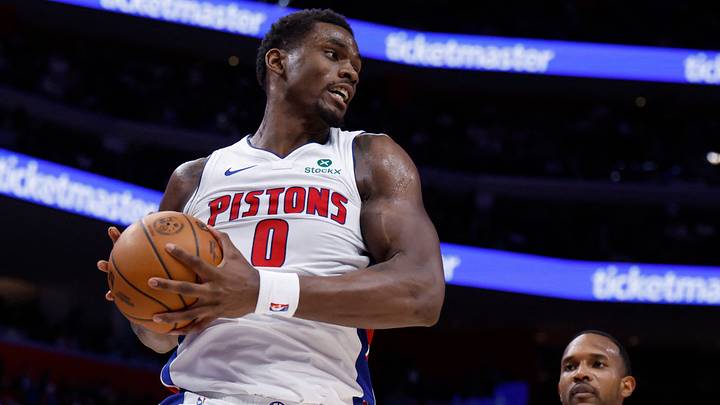
The contract talks between the Detroit Pistons and Jalen Duren are continuing, but a resolution isn't expected any time soon. There seems to be a stalemate between the sides, which could last all the way until October 1, which is Duren's deadline to accept a one-year, $9.6 million qualifying offer.
This has certainly been frustrating to follow for Pistons fans. It's tough not knowing whether your star center will be back this late into the offseason. It's also understandable that the fans may be upset or angry at the front office or Duren.
In reality, both sides are doing the right thing. As annoying as the prolonged uncertainty can be, this is the correct approach for both the Pistons and Duren.
It will take some time but Duren and Detroit should come to an agreement
Detroit has some leverage in the situation. They know that Duren doesn't have a market since there are no teams with cap space. The only way for Duren to get himself on a different team is by a sign-and-trade. And the Pistons aren't doing that because they understandably believe that Duren taking the qualifying offer is not a real threat.
So, they are playing hardball. Teams tend to hamstring their future flexibility by overpaying their own players in these extensions. There is a big difference between the Pistons having Duren on a contract that averages out to $35 million per year versus $44 million, which is Duren's 25% max.
This could be the difference between the Pistons being over the second apron versus not. Or it could be the reason the Pistons are able to sign a difference-maker using the non-taxpayer midlevel exception next summer.
Duren's stance also makes sense. He knows that the Pistons have no way to replace him. They desperately need him to have any chance of being a contender in the near future. He is looking around the league and seeing Walker Kessler making over $32 million in average annual salary or Alperen Sengun making $37 million. He would have every right to demand larger contracts than these players after putting together an All-NBA campaign.
Sure, taking the qualifying offer may not be a real threat. There are also no teams making a sign-and-trade offer that would make the Pistons think twice. What is a real threat to Detroit, however, is having an unhappy Duren. Could he not sign a short-term deal with the Pistons to try to hit the market again soon, then request a trade to get himself to a team that would give him what he is looking for?
Duren is also using all the leverage he has. It may not seem like it's as big a leverage as the Pistons', but he has some. He has no incentive to take Detroit's lowball offers at this stage in the offseason. There is no downside to continuing the standoff for Duren until the Pistons get their offer somewhere the All-Star center is comfortable taking.
That won't be the 25% max Duren is looking for. If it lands somewhere between $35 and $40 million per year, it could be a win for both sides. We may have to wait a little longer, however, before each side gets there.
 Add us as a preferred source on Google