

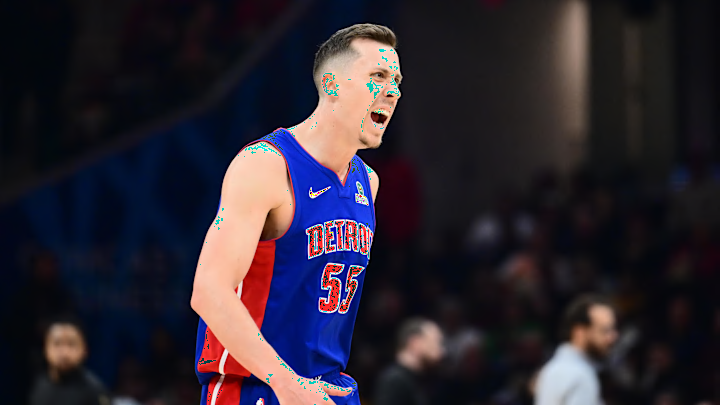
At 28-9, the Detroit Pistons have exceeded all expectations so far this season. With increased expectations, however, come added pressure. The Pistons now have to act like a championship contender. This means that there needs to be very few weaknesses that can be exploited in the playoffs. While most of Detroit's weaknesses are on the offensive side of the ball, the Pistons can't ignore the defensive shortcomings of Duncan Robinson.
As the only elite perimeter shooter on the team, Robinson clearly plays a big role for the Pistons. He provides much-needed spacing and three-point volume, making things easier for Cade Cunningham and Jalen Duren. On the other hand, his defense remains a big concern.
Duncan Robinson's Defense Is a Big Concern for the Pistons
Robinson is easily the worst defensive player on the roster. Since the Pistons are an elite defensive team with almost no weak individual defenders other than Robinson, they can hide the veteran sharpshooter's shortcomings. In a playoff setting, however, this will be harder to do. In the postseason, you are only as good as your weakest defender since teams relentlessly target the weak defenders. This will especially be true against the Pistons, since there are no other obvious places to attack.
This is already happening in the regular season. Teams consistently look for the switch to get Robinson on their ball-handler. They put Robinson in the action to take advantage of his lack of strength and athleticism. This will only increase as the Pistons go further in the playoffs.
Detroit is 8.6 points per 100 possessions worse defensively with Robinson on the floor than off, per Cleaning the Glass. With Robinson, the Pistons have a 113.6 defensive rating, which would be the tenth-best unit in the league. That's a good mark, but it's nowhere near the 105.0 defensive rating the Pistons have without Robinson, which is even better than the Oklahoma City Thunder's historic, league-leading defense.
Robinson creates a fascinating dilemma for the Pistons. They really need him offensively, so head coach JB Bickerstaff can't afford to take him out, highlighted by his 29.1 minutes per game, the second-highest on the team. Whenever he is out there, however, especially in the clutch, he has a target on his back, making the Pistons an easier team to attack.
That is why the Pistons need to upgrade Robinson's spot in the rotation. For the $16.8 million he is making this season, the Pistons can find a shooter who isn't as big a defensive liability as Robinson is. They may need to use some of their draft capital at the trade deadline to acquire this upgrade, but it behooves the Pistons not to ignore this problem if they want to make a deep postseason run.
More Detroit Pistons News and Rumors:
 Add us as a preferred source on Google